

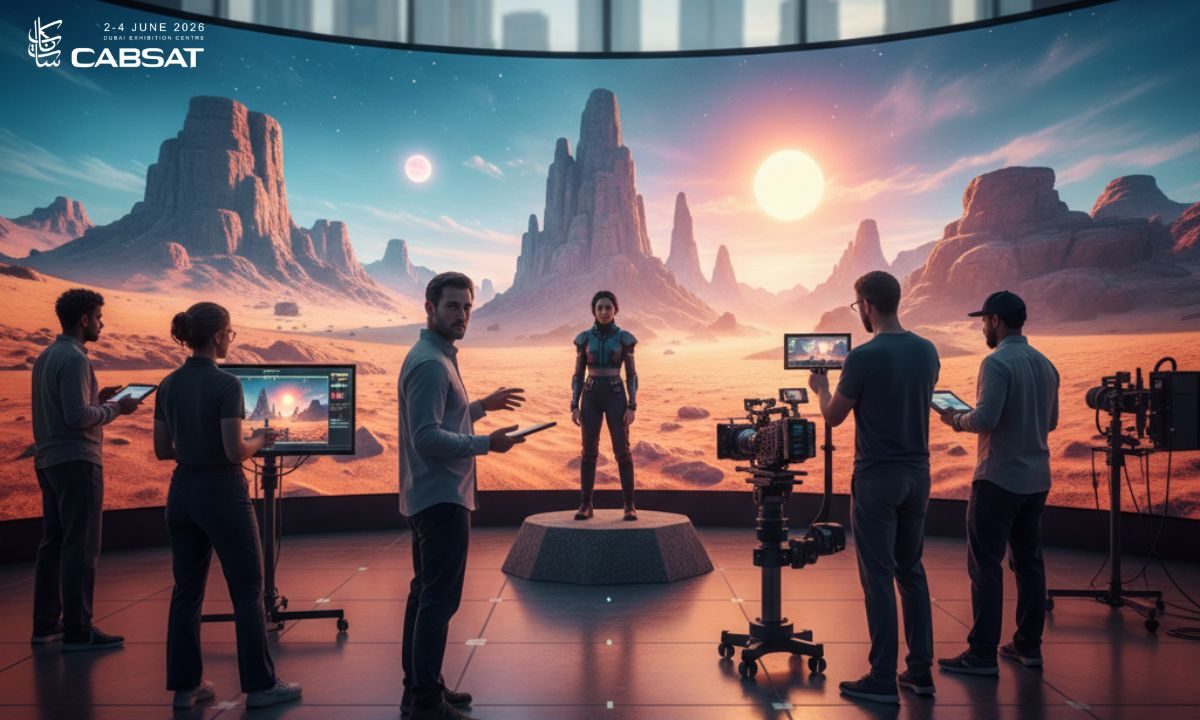
Conventional advice says to wait until the tools mature. That approach now wastes time and budget. I argue for a pragmatic embrace of virtual production technology. Not hype. A measured, studio-ready stack that reduces risk and accelerates delivery while raising the creative ceiling.
Leading Virtual Production Studios and Software Solutions
UAE Virtual Production Studios Driving Regional Innovation
The UAE has moved from curious observer to credible builder. Major industry platforms are also showcasing how modern virtual production studios are evolving with LED volumes, real-time engines, and integrated camera tracking systems. I have seen virtual production technology there evolve from pilot rigs to robust stages. A telling example is the first fully integrated studio in Dubai, which launched with a significant LED wall and on-set visualisation. As A TOUR OF THE UAE'S FIRST VIRTUAL PRODUCTION STUDIO reported, the facility installed a 24x5m surface to support commercials, drama, and live events.
What matters is not only the wall, but the mindset. Teams now design content around interactive backdrops and precise lighting responses. That shift changes scheduling, shot design, and how directors iterate. It also pushes vendors to tailor displays and camera pipelines to local needs. The region is not copying Hollywood. It is building fit-for-purpose virtual production studios for advertisers, broadcasters, and government projects.
- Creative control on set, with immediate feedback and fewer reshoots.
- Reduced logistics, especially for location-heavy scripts.
- Predictable schedules through previsualised scenes and locked asset libraries.
In short, virtual production technology in the UAE is now a strategic capability. Not a showpiece.
Essential Virtual Production Software Platforms
Two categories dominate my short list. First, real-time engines that drive imagery. Second, orchestration layers that handle keying, camera IO, and stage control. Aximmetry is a strong example in the latter group. As Aximmetry Virtual Production Platform outlines, the tool integrates chroma workflows, Unreal connectivity, and a node-based editor for broadcast or events.
For rendering engines, I prioritise projects that need photoreal scenes, scalable asset management, and deterministic frame timing. Unreal Engine often leads here, with Unity remaining relevant for interactive, lighter footprints. I add specialist renderers to the mix for design reviews or look development. The goal is a stable virtual production software stack that avoids brittle handoffs.
My rule of thumb is simple. Pick fewer tools that integrate cleanly. Then enforce version control and deterministic builds. That discipline safeguards the virtual production workflow when the schedule tightens. And it always does.
Real-Time Rendering and Game Engine Technologies
Real-time engines no longer play second fiddle to offline renders for on-set decisions. They now drive lighting choices, blocking, and lens selection. Engines such as Unreal and Unity provide robust pipelines for virtual cameras, nDisplay style multi-output, and live compositing. The gap between offline polish and real-time output narrows every quarter. Roughly speaking, it is close enough for many use cases.
I use a simple decision frame:
- Real-time when interactive lighting, live talent reactions, or rapid iteration is required.
- Offline when complex caustics, extreme close-ups, or heavy simulations dominate.
Either way, virtual production technology benefits from common scene graphs, consistent colour management, and calibrated camera LUTs. That is the quiet work that protects results on the day.
Virtual Production Equipment and Technical Infrastructure
LED Volume Technology and Display Systems
LED volumes are the signature surface of virtual production equipment. Innovations from companies like Alfalite and Brainstorm Multimedia highlight how advanced LED panels and real-time rendering workflows are redefining virtual production environments. Brightness, pixel pitch, scan mode, and refresh behaviour all influence moire, rolling-shutter artefacts, and perceived depth. One broadcast-grade option, the LBAE026, lists a 2.60 mm pitch and 1,500 nits, plus curved installation support. As Indoor LED LBAE026 - Virtual Production details, its design targets camera performance and serviceability.
Operationally, I care about three things:
- Colour coherence across tiles after hours of heat load.
- Low-latency genlock to the camera chain.
- Maintainability, because panels will need swaps mid-shoot.
Adoption is climbing at pace. As LED volume making waves in virtual production notes, the installed base of ICVFX volumes reached about 200 by the end of 2023, with growth forecast in smaller stages too.
Right fit beats raw size. A well-calibrated mid-size volume with disciplined workflows often outperforms a giant wall run loosely.
Camera Tracking and Motion Capture Systems
Reliable tracking is non-negotiable. Optical constellations, IMU hybrids, and encoded heads each have roles. The principle is straightforward. The virtual camera must mimic the physical camera in position, rotation, lens distortion, and sometimes focus and iris. Otherwise parallax breaks and the composite looks wrong. It is basically the difference between a convincing perspective and a plate that floats.
For character work, I add marker-based or markerless mocap to drive secondary motion and eyelines. That keeps performances grounded when backgrounds are synthetic. Tooling matters less than proper calibration and drift monitoring. Quiet rigour wins here.
Integration of Hardware and Software Components
Virtual production technology succeeds or fails on integration. LED processors, sync generators, tracking systems, and render nodes must negotiate genlock, timecode, and colour transforms. I standardise on shared timing, explicit device drivers, and a single source of truth for colour. Without that, small inconsistencies multiply quickly.
| Component | Integration focus |
|---|---|
| LED processors | Frame mapping, bit-depth, scan timing |
| Camera chain | Shutter angle, sensor timing, lens metadata |
| Tracking | Latency budget, smoothing, coordinate alignment |
| Render nodes | Clock sync, colour pipeline, content distribution |
I encourage a modular design that allows hot-swaps. Servers fail. Tracking recalibrates. Panels drop. With a resilient blueprint, the show continues and the audience never notices.
Modern Virtual Production Workflows and Techniques
Pre-Production Planning and Visualisation
Front-loading the plan is the highest ROI move. I start with previs and techvis that encode lenses, stage footprint, and camera paths. That artefact becomes the north star for art, lighting, and asset teams. It also clarifies what the LED must carry versus what can remain off-wall as set dressing.
I push for three assets before day one:
- A scene bible with hero looks, LUTs, and exposure references.
- A blocking board that includes tracking markers and safe walkable zones.
- A content manifest mapping wall sections to content IDs and versions.
This paperwork is not theatre. It keeps virtual production workflow choices aligned with schedule risk. It also protects the budget from late asset churn. That matters.
On-Set Production and ICVFX Implementation
On set, clarity of roles is essential. I assign a stage supervisor to arbitrate between DP, VFX, and content ops. One person, clear calls. Then I run tight look dev passes at call time to stabilise exposure, white point, and tracking offsets. Only then do I roll talent.
ICVFX is the accelerant when used properly. Directors see the world in camera and can reframe without guesswork. Performers react to real parallax and light. Editorial choices improve. And yet, there are trade-offs. Lock too much in camera and post loses optionality. I set a line. Keep foreground truthy and leave non-critical depth for later polish.
A brief example helps. A sports promo required a twilight cityscape with reflective glass. We built a pared-down volume plate and added a practical window frame. The DP matched interactive reflections with a few flagged units and plate-side tweaks. The grade came back almost final. Two pick-ups, then delivery. No scramble.
Post-Production Integration and Finishing
When the on-set plan is tight, post becomes integration and finesse. Colour workflows carry through with minimal translation. Editors work with near-final imagery. VFX focuses on augmentation, not rescue. The finishing pass then handles polish across shots for continuity and taste.
There are pitfalls. Colour drift from panel heat. Tracking jitter near occlusions. Mismatched motion blur. I mitigate with disciplined calibration logs, slate-based metadata capture, and QC gates at defined clip milestones. If something slips, we know where and why.
Virtual production technology does not erase posts. It reframes it as a controlled, high-value phase where creative decisions are preserved from set to screen.
The Future of Virtual Production Technology
The next chapter looks pragmatic rather than flashy. Expect smaller, smarter volumes, better colour pipelines, and tighter engine integration with cameras. I anticipate more facilities using mixed approaches. Some shots on LED, some on chroma, some full CG. Choose the right tool for creative intent and budget. Not ideology.
Two developments excite me:
- Camera-aware rendering where lens data modulates shading live for truer integration.
- Asset provenance tracking so teams trust what is on the wall and who approved it.
Virtual production technology will likely become invisible infrastructure. Like DI or matched audio. It just works in the background while storytelling takes the foreground. That is real progress.